
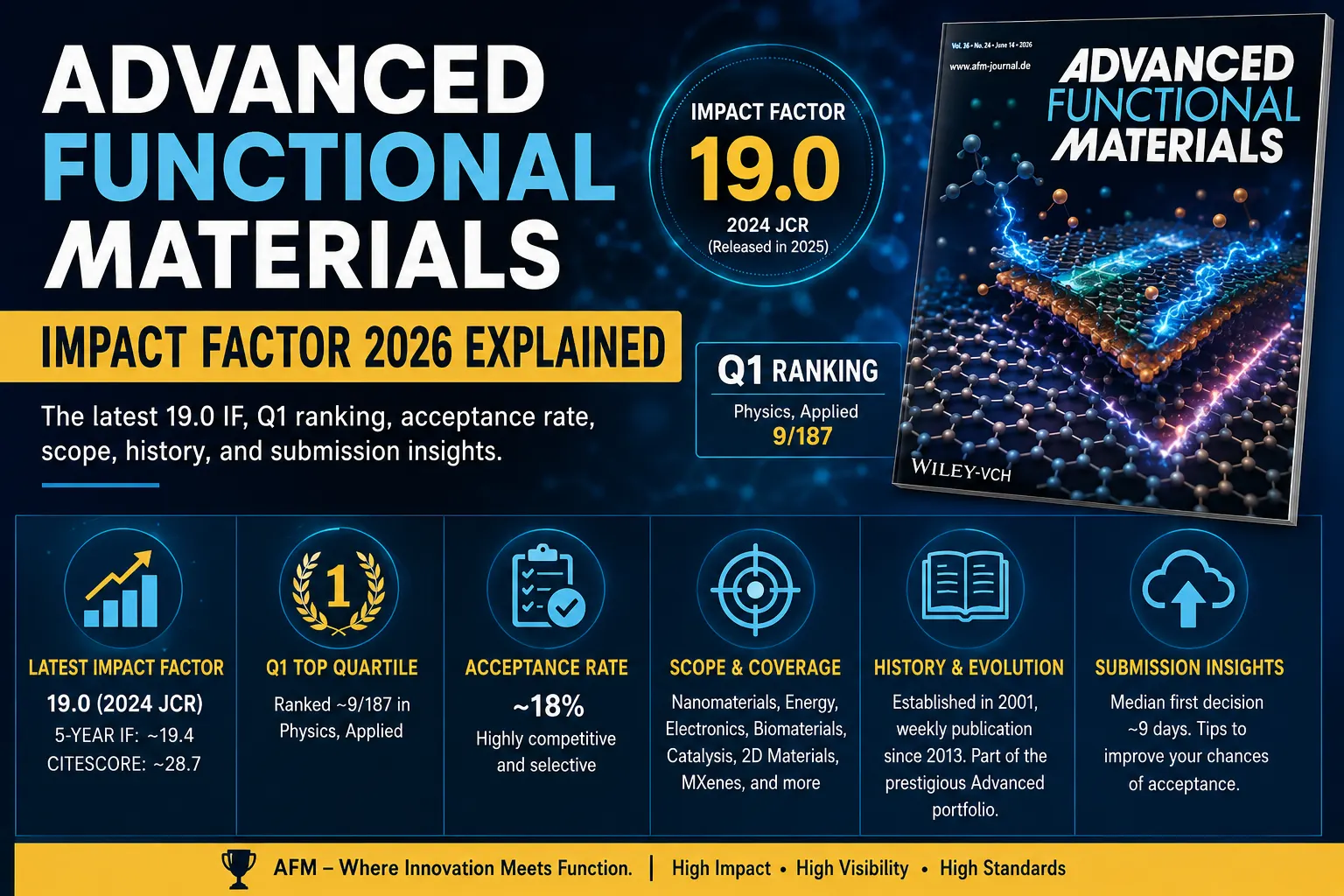
Advanced Functional Materials Impact factor 2026 explained the latest 19.0 IF, Q1 ranking, acceptance rate, scope, history, and submission insights.
Table of Contents
Advanced Functional Materials Impact factor 2024: Complete Journal Analysis
Advanced Functional Materials Impact factor (AFM) is one of the most prestigious peer-reviewed journals in materials science today. Published by Wiley‑VCH, the journal is globally recognized for publishing high-impact, application-oriented research in functional materials.
As of the 2024 Journal Citation Reports (JCR), released in 2025, Advanced Functional Materials Impact factor holds a Journal Impact Factor (JIF) of 19.0, firmly placing it in Q1 (top quartile) across multiple subject categories, including Physics, Applied.
This article provides a complete SEO-optimized breakdown of AFM’s impact factor, ranking, scope, history, acceptance rate, and why it remains one of the most influential journals for researchers in materials science, nanotechnology, energy, electronics, and biomaterials.
What Is the Impact Factor of Advanced Functional Materials?
Latest Impact Factor (2024)
- Journal Impact Factor (JIF): 19.0
- Five-Year Impact Factor: ~19.4
- Quartile Ranking: Q1
- Physics, Applied Ranking: ~9/187
- CiteScore: ~28.7
- Acceptance Rate: ~18%
- Median Time to First Decision: ~9 days
The Advanced Functional Materials Impact factor of 19.0 means that, on average, articles published in AFM during 2022–2023 were cited 19 times in 2024.
This positions AFM among the top-tier materials science journals globally.
Understanding Impact Factor: Why It Matters for AFM
What Is Journal Impact Factor?
The Journal Impact Factor (JIF) is calculated annually by Clarivate Analytics through the Journal Citation Reports (JCR). It measures:
The average number of citations received per citable article over a two-year period.
Why AFM’s Impact Factor Is Significant
A high impact factor like 19.0 indicates:
- Strong global visibility
- High citation velocity
- Broad interdisciplinary relevance
- Prestige for academic promotions, grants, and tenure
For materials science where thousands of papers are published every year—this level of citation performance reflects exceptional influence.
Advanced Functional Materials Impact factor Trend (2017–2024)
Historical Impact Factor Growth
| Year | Impact Factor |
|---|---|
| 2017 | ~13.3 |
| 2018 | ~15.6 |
| 2019 | ~16.8 |
| 2020 | 18.8 |
| 2021 | 19.9 (Peak) |
| 2022 | 19.0 |
| 2023 | 18.5 |
| 2024 | 19.0 |
Key Observations
- Strong long-term growth trend
- Minor dip during post-pandemic citation normalization
- Rapid recovery and stabilization
- Low self-citation rate (JIF without self-cites ~17.7)
This stability makes AFM more reliable than many volatile high-IF journals.
History and Evolution of Advanced Functional Materials
Origins of the Journal
Advanced Functional Materials Impact factor has a rich publishing history, evolving from earlier Wiley journals:
- Journal of Molecular Electronics (1985–1991)
- Chemtronics (1986–1991)
- Advanced Materials for Optics and Electronics (1992–2000)
AFM was officially established in February 2001, continuing the volume numbering.
Publication Growth Timeline
- 2002 – Monthly publication
- 2006 – 18 issues per year
- 2008 – Biweekly
- 2013–Present – Weekly (~52 issues/year)
This expansion mirrors the explosive growth of nanotechnology, energy materials, and applied materials research Advanced Functional Materials Impact factor.
Editorial Leadership and Peer Review Quality
- Editor-in-Chief: Joern Ritterbusch
- Supported by experienced Deputy Editors and Associate Editors
- Known for:
- Rapid but rigorous peer review
- Clear editorial communication
- Fair manuscript handling
Many authors praise AFM for balancing speed with quality control.
Aims and Scope of Advanced Functional Materials
Core Philosophy: “Function First”
AFM prioritizes what a material does, not just how it is synthesized Advanced Functional Materials Impact factor.
To be suitable for AFM, research must demonstrate:
- Clear functional performance
- Application relevance
- Robust experimental validation
Key Research Areas Covered by AFM
Major Subject Domains
- Nanotechnology and nanomaterials
- Energy materials (batteries, photovoltaics, supercapacitors)
- Electronics and optoelectronics
- Biomaterials and biomedical engineering
- Sensors, actuators, and smart materials
- Catalysis and photocatalysis
- Magnetic materials and spintronics
- Polymers, hybrids, and composites
- 2D materials, MXenes, perovskites
Examples of High-Impact Topics
- MoS₂ transistors
- Artificial synapses and memristors
- MXene oxidation mechanisms
- Cancer therapy via membrane-active materials
- CO₂ reduction catalysts
- Luminescent phosphors
Why Is Advanced Functional Materials So Highly Cited?
1. Interdisciplinary Reach
AFM papers appeal to:
- Chemists
- Physicists
- Engineers
- Biomedical researchers
This cross-disciplinary nature boosts citation potential Advanced Functional Materials Impact factor.
2. Strong Application Focus
Journals emphasizing device performance, real-world testing, and scalability naturally attract more citations.
3. Fast Publication Cycle
- Weekly issues
- Median first decision ~9 days
- Rapid online publication
4. Strong Brand Recognition
The Advanced journal family ensures:
- High discoverability
- Broad readership
- Cross-journal visibility
Comparison with Related High-Impact Journals
Advanced Functional Materials vs Advanced Materials
| Feature | AFM | Advanced Materials |
|---|---|---|
| Impact Factor | ~19.0 | ~26–27 |
| Acceptance Rate | ~18% | ~6% |
| Focus | Functional applications | Breakthrough concepts |
| Selectivity | High | Extremely high |
AFM is often the next best destination for strong, application-driven work that may be too specialized for Advanced Functional Materials Impact factor.
Acceptance Rate and Submission Selectivity
How Competitive Is AFM?
- Acceptance Rate: ~12–18%
- Strong emphasis on:
- Novelty
- Functionality
- Reproducibility
- Application relevance
AFM rejects:
- Incremental studies
- Purely descriptive materials synthesis
- Weak device performance claims
Submission Tips to Get Published in AFM
What Editors Look For
Strong Fit
- Demonstrated functional performance
- Clear real-world relevance
Robust Data
- Comprehensive characterization
- Reproducibility
- Application benchmarks
Clear Writing
- Broad accessibility
- Logical structure
- High-quality figures
Ethical Standards
- Strict data integrity
- Transparent methodology
Open Access Options and Publication Cost
AFM follows a hybrid open-access model.
- Optional Gold Open Access
- Article Processing Charge (APC): ~USD 5,790
- Open access significantly improves reach and citations
Broader Impact: Why AFM Matters to Materials Science
Emerging Research Trends Featured in AFM
- AI-driven materials discovery
- Sustainable and green materials
- Neuromorphic computing
- Bio-inspired materials
- Flexible and wearable electronics
- Quantum and spintronic materials
The journal closely tracks future-defining technologies.
Limitations of Impact Factor (Critical Perspective)
While AFM’s impact factor is impressive, it has limitations:
- Field-dependent citation behavior
- Does not measure societal impact directly
- May encourage citation-driven publishing
However, AFM mitigates this through rigorous editorial standards.
Future Outlook of Advanced Functional Materials
Looking ahead, AFM is expected to:
- Maintain a strong IF around 18–20
- Expand coverage of AI-enabled materials
- Lead in sustainability-focused materials research
- Continue attracting top global submissions
Frequently Asked Questions (PAA Optimized)
Is Advanced Functional Materials a Q1 journal?
Yes, AFM is consistently ranked in Q1 (top quartile) across relevant subject categories.
What is the current impact factor of AFM?
The 2024 impact factor is 19.0, released in 2025.
Is Advanced Functional Materials hard to publish in?
Yes. With an acceptance rate below 20%, AFM is highly selective.
Is AFM better than Advanced Materials?
They serve different purposes. Advanced Materials focuses on breakthroughs, while AFM emphasizes functional applications.
Does AFM accept review articles?
Yes. Feature articles and reviews are accepted, usually by invitation or strong proposal.
Conclusion
Advanced Functional Materials Impact factor stands as one of the most influential journals in materials science, with a 19.0 impact factor, global prestige, and a strong application-driven focus. Its stable citation performance, rigorous peer review, and interdisciplinary reach make it a top destination for high-quality functional materials research.
Whether you are a researcher aiming to publish, a student evaluating journals, or a blogger tracking scientific trends, AFM represents excellence at the intersection of discovery and real-world application.

Hi, I’m Sanskar Shinde — a civil engineer, blogger, and construction enthusiast. With 3 years of experience in the field, I love sharing real-world tips, project ideas, and practical knowledge through my blog, Brahma Constructions.