
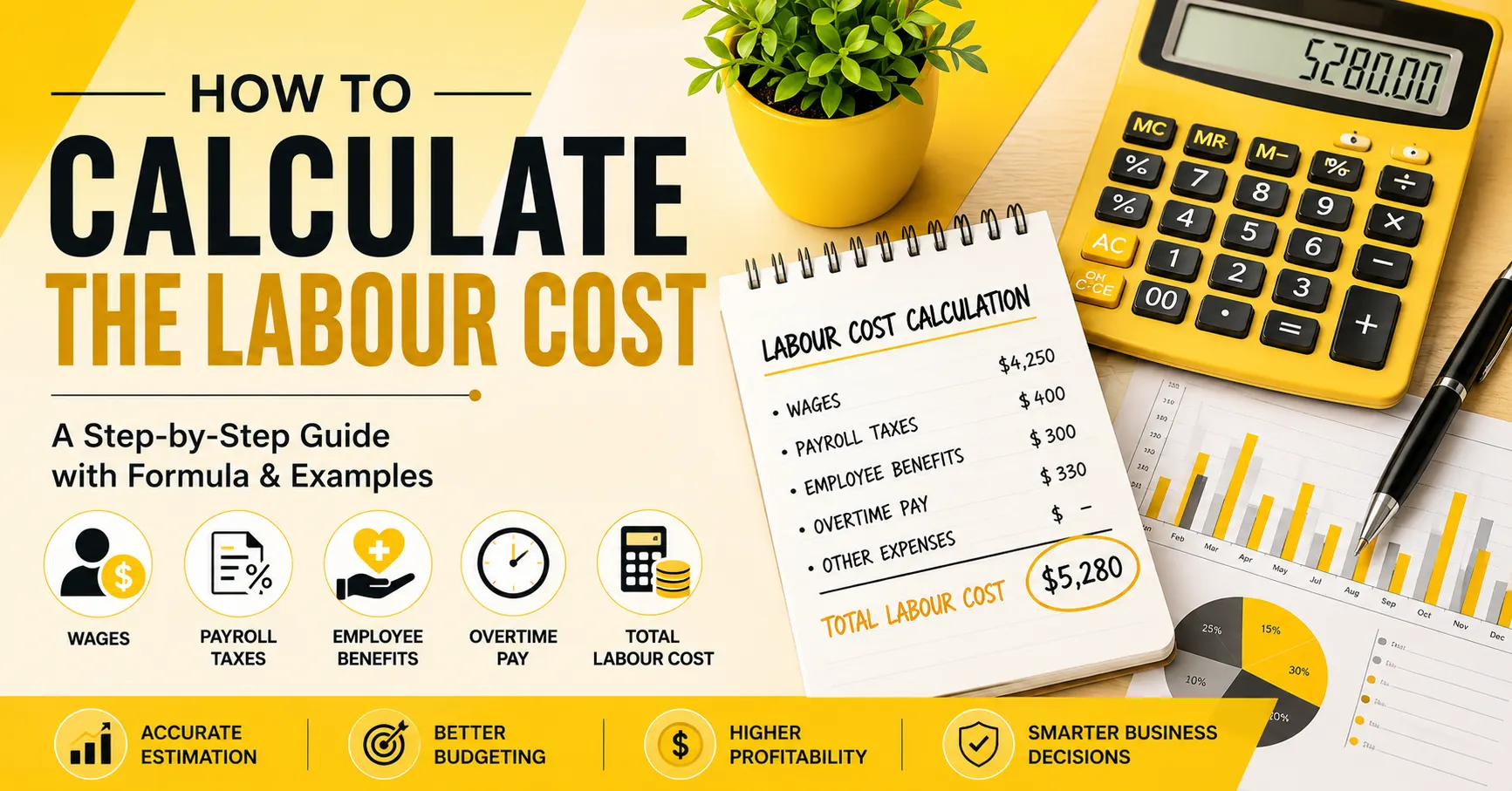
Learn how to calculate the labour cost with easy formulas, examples, and tips. Calculate wages, payroll taxes, benefits, and labour costs accurately.
Labour cost is one of the most important expenses for any business. Whether you own a small business, manage a construction project, run a manufacturing company, or provide professional services, understanding how to calculate the labour cost helps you set accurate prices, improve profitability, and make better financial decisions.
Many business owners focus only on employee wages, but labour cost includes much more than hourly pay. Payroll taxes, employee benefits, overtime, insurance, paid leave, and other employment-related expenses all contribute to the total labour cost.
In this guide, you’ll learn how to calculate the labour cost, understand the formula, explore real-life examples, discover common mistakes to avoid, and find practical tips to manage labour expenses effectively.
What Is Labour Cost?
Labour cost is the total amount a business spends on its employees. It includes both direct wages and additional employment expenses required to keep workers on the payroll.
Labour cost typically includes:
- Regular wages or salaries
- Overtime pay
- Payroll taxes
- Employee benefits
- Paid vacation and sick leave
- Retirement contributions
- Insurance costs
- Bonuses and incentives
- Training expenses
Knowing the complete labour cost provides a more accurate picture of business expenses than looking at wages alone.
Why Is It Important to Calculate Labour Cost?
Calculating labour cost accurately helps businesses make informed decisions. It allows you to:
- Set profitable prices for products and services.
- Prepare accurate project estimates.
- Control business expenses.
- Improve budgeting and financial planning.
- Increase operational efficiency.
- Measure employee productivity.
- Identify opportunities to reduce unnecessary costs.
Without calculating labour cost correctly, businesses may underprice their services and reduce their overall profits.
How to Calculate the Labour Cost: The Basic Formula
The simplest formula is:
Labour Cost = Employee Wages + Payroll Taxes + Employee Benefits + Other Labour Expenses
If you want the labour cost per hour, use this formula:
Labour Cost Per Hour = Total Labour Cost ÷ Total Hours Worked
This calculation gives you the true hourly cost of employing a worker.
Step 1: Determine the Total Hours Worked
Start by calculating the total number of hours worked during the selected period.
Include:
- Regular working hours
- Overtime hours
- Paid working hours
Exclude unpaid leave unless your company policy requires otherwise.
For example:
- Regular hours: 160
- Overtime: 10
Total hours worked = 170 hours
Step 2: Calculate Employee Wages
Multiply the employee’s hourly wage by the total hours worked.
Example:
Hourly wage = $25
Hours worked = 170
Employee wages = 170 × $25 = $4,250
If employees receive a fixed monthly salary, simply use the monthly salary as the wage amount.
Step 3: Add Payroll Taxes and Employee Benefits
Employee wages are only one part of labour cost.
Additional expenses may include:
- Payroll taxes
- Health insurance
- Retirement contributions
- Paid leave
- Workers’ compensation insurance
- Performance bonuses
Example:
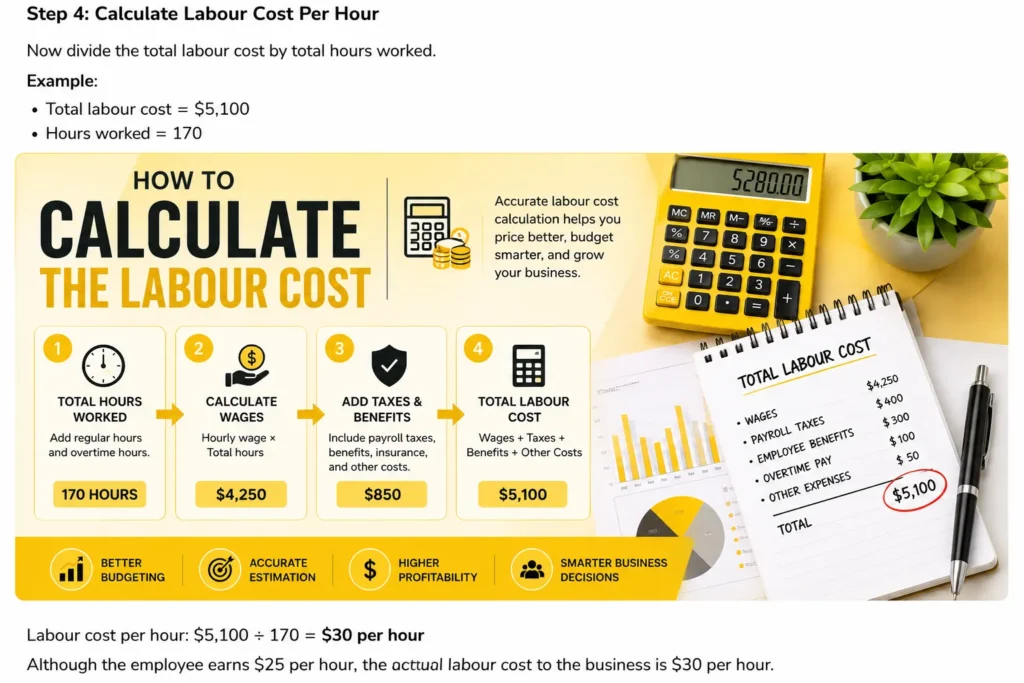
Employee wages: $4,250
Payroll taxes: $400
Health insurance: $300
Retirement contribution: $150
Total labour cost = $5,100
Step 4: Calculate Labour Cost Per Hour
Now divide the total labour cost by total hours worked.
Example:
Total labour cost = $5,100
Hours worked = 170
Labour cost per hour:
$5,100 ÷ 170 = $30 per hour
Although the employee earns $25 per hour, the actual labour cost to the business is $30 per hour.
Example of How to Calculate the Labour Cost
Let’s look at a complete example.
A construction worker earns:
- Hourly wage: $28
- Hours worked: 160
- Overtime: 20 hours
- Payroll taxes: $500
- Benefits: $450
Step 1
Regular wages:
160 × $28 = $4,480
Step 2
Overtime:
20 × $42 = $840
Step 3
Total wages:
$4,480 + $840 = $5,320
Step 4
Add taxes and benefits:
Payroll taxes = $500
Benefits = $450
Total labour cost:
$5,320 + $500 + $450 = $6,270
Total hours:
180 hours
Labour cost per hour:
$6,270 ÷ 180 = $34.83 per hour
This example shows why businesses should never calculate labour cost based only on wages.
Direct Labour Cost vs. Indirect Labour Cost
Understanding the difference between direct and indirect labour helps businesses allocate costs correctly.
Direct Labour Cost
Direct labour refers to employees directly involved in producing products or delivering services.
Examples include:
- Factory workers
- Construction workers
- Carpenters
- Electricians
- Machine operators
Indirect Labour Cost How to Calculate the Labour Cost
Indirect labour includes employees who support business operations but do not directly produce goods or services.
Examples include:
- Office staff
- Human resources
- Security personnel
- Supervisors
- Maintenance staff
Both types of labour contribute to total business expenses.
Factors That Affect Labour Cost Calculations
Several factors influence labour cost.
Employee Experience
Experienced employees generally earn higher wages.
Overtime
Frequent overtime significantly increases labour expenses.
Benefits
Health insurance, retirement plans, bonuses, and paid leave all add to labour costs.
Payroll Taxes
Employer tax obligations vary depending on local regulations.
Industry Requirements
Construction, healthcare, and manufacturing often have higher labour costs than many service industries.
Common Mistakes When Calculating Labour Cost
Businesses often make mistakes that lead to inaccurate pricing and budgeting How to Calculate the Labour Cost.
Ignoring Employee Benefits
Benefits can account for a significant portion of total labour expenses.
Forgetting Payroll Taxes
Employer payroll taxes should always be included.
Excluding Overtime
Overtime wages increase labour cost substantially.
Not Tracking Actual Hours
Estimating employee hours instead of tracking them accurately can distort labour cost calculations.
Using Only Hourly Wages
Hourly wages alone do not represent the actual cost of employing workers.
Tips to Reduce Labour Costs Without Affecting Productivity
Reducing labour cost does not necessarily mean reducing staff.
Consider these strategies:
- Improve employee scheduling.
- Reduce unnecessary overtime.
- Invest in employee training.
- Automate repetitive tasks.
- Monitor productivity regularly.
- Cross-train employees for multiple roles.
- Use workforce management software.
- Improve workflow efficiency.
These practices help businesses control expenses while maintaining productivity How to Calculate the Labour Cost.
Tools That Help You Calculate Labour Cost
Many businesses use software to simplify labour cost calculations.
Popular options include:
- Payroll software
- Time-tracking applications
- Workforce management systems
- Accounting software
- Project management tools
- Spreadsheet templates
These tools reduce manual errors and improve financial reporting.
Frequently Asked Questions About How to Calculate the Labour Cost
What is the formula for calculating labour cost?
The basic formula is:
Labour Cost = Wages + Payroll Taxes + Employee Benefits + Other Employment Expenses
How do you calculate labour cost per hour?
Divide the total labour cost by the total hours worked.
Labour Cost Per Hour = Total Labour Cost ÷ Total Hours Worked
What is included in labour cost?
Labour cost includes wages, salaries, overtime, payroll taxes, employee benefits, insurance, retirement contributions, bonuses, and paid leave How to Calculate the Labour Cost.
How do you calculate labour cost for a project?
Add together the labour cost of every employee working on the project, including wages, overtime, taxes, and benefits. This provides the total labour cost for the project How to Calculate the Labour Cost.
Best Practices for Accurate Labour Cost Calculation
To maintain accurate labour cost records:
- Track employee hours daily.
- Review payroll reports regularly.
- Update employee benefit costs annually.
- Monitor overtime carefully.
- Calculate labour costs monthly.
- Compare labour costs with revenue.
- Use reliable accounting software for record-keeping.
Regular monitoring helps businesses stay profitable and identify cost-saving opportunities.
Conclusion: How to Calculate the Labour Cost Accurately
Learning how to calculate the labour cost is essential for every business owner, contractor, project manager, and financial professional. By including wages, overtime, payroll taxes, employee benefits, and other employment-related expenses, you can determine the true cost of your workforce.
Accurate labour cost calculations lead to better pricing, smarter budgeting, improved profitability, and more informed business decisions. Whether you’re estimating a project, preparing payroll, or analyzing business performance, following the steps outlined in this guide will help you calculate labour costs with confidence and precision.

Hi, I’m Prajyot Patil — a civil engineer, blogger, and construction enthusiast. With 3 years of experience in the field, I love sharing real-world tips, project ideas, and practical knowledge through my blog, Brahma Constructions.