

Learn Mivan construction technology, Aluminium formwork system, process, advantages, disadvantages, cost in India, and comparison with conventional construction.
Table of Contents
Introduction to Mivan Construction
Mivan’s construction is a modern building technology that is widely used in India for fast and large-scale housing projects. This method uses an aluminium formwork system to cast walls, slabs, beams, and columns together in a single concrete pour, creating a strong monolithic structure. Compared to conventional brick and RCC construction, Mivans technology helps reduce construction time while maintaining uniform quality and durability.
Due to its speed and efficiency, Mivans construction is commonly adopted in mass housing, residential apartments, and affordable housing projects. The smooth wall finish achieved through aluminium formwork reduces plaster work and overall material wastage. Although the initial cost is higher, Mivans construction becomes cost-effective for large projects because of savings in labour, time, and maintenance.
With the growing demand for rapid and sustainable construction in India, Mivans technology is becoming an important solution for modern urban development.
What is Mivan Construction?
Mivan construction is a modern building technology that uses an aluminium formwork system to construct walls, slabs, beams, and columns together in a single concrete pour. Unlike conventional construction, where brickwork and RCC members are built separately, Mivans creates a monolithic concrete structure.
How Mivan Technology Works
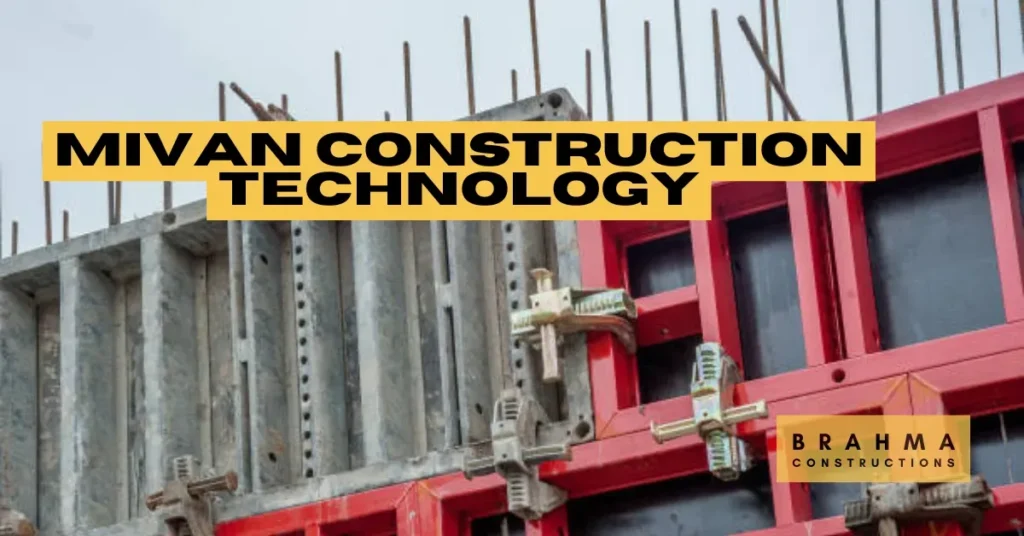
In this method, aluminium panels are assembled on site to form moulds for the entire building unit. Steel reinforcement is placed inside the formwork, and concrete is poured at once. After curing, the formwork is removed and reused for the next cycle.
Why It Is Called Monolithic Construction
Since all structural components are cast together, the building acts as one solid unit. This improves strength, durability, and load transfer.
Mivans construction is mainly used in large residential and mass housing projects, where speed, quality, and uniformity are important. Due to its smooth wall finish, plaster work is minimal, which further saves time and cost.
Why Mivan Technology is Popular in India
Mivan technology has gained popularity in India mainly because of the growing demand for fast and affordable housing. Government housing schemes and private developers prefer this system for large-scale projects.
Faster Construction Speed
One of the biggest reasons for its popularity is speed. A floor cycle can be completed in 7–10 days, which is much faster than conventional construction methods.
Uniform Quality and Finish
Since aluminium formwork is factory-made, it provides accurate dimensions and smooth surfaces. This ensures uniform quality across all housing units.
Suitable for Mass Housing
Mivans construction is ideal for projects where the same layout is repeated multiple times, such as apartments and townships.
Due to reduced labour dependency, less material wastage, and faster project completion, Mivans construction helps builders save overall project costs while maintaining quality.
Main Materials Used in Mivan’s Construction
The success of Mivan construction depends on the quality of materials used. Each component plays an important role in strength and speed.
Aluminium Formwork System
Aluminium panels are lightweight, strong, and reusable. These panels form the mould for walls, slabs, beams, and columns.
Concrete and Reinforcement
High-strength concrete is used to achieve early strength. Steel reinforcement is placed as per structural design to resist loads.
Supporting Accessories
Wall ties, pins, wedges, props, and brackets are used to support the formwork during concreting. These ensure alignment and stability.
Because aluminium formwork can be reused 200–300 times, it becomes economical for large projects. Proper handling and maintenance of materials are essential to achieve good results and long service life of the formwork system.
Step-by-Step Mivan Construction Process
The Mivan construction process follows a planned and repetitive cycle, which helps achieve fast construction.
Step 1: Formwork Assembly
Aluminium panels are fixed according to drawings to form walls and slabs. Proper alignment and tight joints are checked.
Step 2: Reinforcement Placement
Steel bars, conduits, and service pipes are placed inside the formwork before concreting.
Step 3: Concreting in One Pour
Concrete is poured for walls and slabs together, creating a monolithic structure.
Step 4: Curing and De-shuttering
After 24–36 hours, formwork is removed and curing is continued. Panels are reused for the next cycle.
This systematic process reduces construction time and improves quality control.
Advantages of Mivan Construction
The advantages of Mivan construction make it suitable for modern housing needs.
Major Benefits
- Very fast construction speed
- Smooth wall finish with less plaster
- High structural strength
- Better earthquake resistance
- Less material wastage
Long-Term Performance
Monolithic construction reduces cracks and leakage problems. Maintenance cost is also lower over time.
Due to accurate formwork and quality control, buildings constructed using Mivans technology have better durability and appearance compared to conventional methods.
Disadvantages of Mivan Construction
Despite its benefits, Mivan construction also has some limitations.
High Initial Cost
The initial investment for aluminium formwork is high, which is not suitable for small projects.
Limited Design Flexibility
Changes in design after formwork preparation are difficult and costly.
Skilled Labour Requirement
Proper training is required for workers to assemble and handle the formwork correctly.
Post-construction modifications like wall cutting are also difficult due to solid concrete walls.
Mivan Construction vs Conventional Construction
Mivan vs conventional construction shows clear differences in speed and flexibility.
Mivan Construction
- Faster execution
- Uniform quality
- Higher initial cost
- Less flexibility
Conventional Construction
- Slower process
- More design flexibility
- Lower initial cost
- More labour-intensive
Mivan is best for large repetitive projects, while conventional methods suit individual buildings.
Cost of Mivan Construction in India
The cost of Mivan construction in India is higher at the start but economical in the long run.
Cost Factors
- Aluminium formwork investment
- Concrete and reinforcement
- Skilled labour
Overall Savings
Due to faster completion, reduced labour, and minimal plaster work, the total project cost decreases for large-scale housing projects.
Quality and Durability of Mivan Structures
Mivan buildings are known for high quality and durability.
Monolithic Strength
Single-pour construction reduces joints, which improves strength and prevents leakage.
Long Service Life
Proper curing and quality concrete increase the lifespan of the structure.
These buildings require less maintenance and perform well under load conditions.
Applications of Mivan Construction
Mivan construction is widely used in:
- Residential apartments
- Affordable housing projects
- Hostels and dormitories
- Large housing townships
It is not suitable for small or irregular projects due to high setup cost.
Mivan Construction for Earthquake-Prone Areas
Due to its monolithic nature, Mivans construction performs better during earthquakes.
Seismic Advantages
- Better load distribution
- Fewer weak joints
- Higher stiffness
This makes it suitable for seismic zones when designed properly.
Future Scope of Mivan Construction Technology
The future of Mivan technology in India is strong.
Growing Demand
With urbanization and housing demand, fast construction methods are essential.
Sustainable Construction
Less waste, faster completion, and durable structures make Mivan a future-ready technology.
Mivan’s construction will continue to grow in large residential and government housing projects.
FAQs on Mivan Construction
❓ What is Mivan construction technology?
Mivan’s construction technology is a modern construction method that uses an aluminium formwork system to cast walls, slabs, beams, and columns together in a single concrete pour. This creates a strong monolithic structure and allows faster construction compared to conventional methods.
❓ Why is Mivan construction used in mass housing projects?
Mivan’s construction is widely used in mass housing because it offers high speed, uniform quality, and cost efficiency for repetitive building layouts. The formwork can be reused many times, making it economical for large residential projects.
❓ What materials are used in Mivan construction?
The main materials used in Mivans constructions include aluminium formwork panels, high-strength concrete, steel reinforcement, wall ties, props, pins, and wedges. These materials help achieve strength, accuracy, and faster construction cycles.
❓ What are the advantages of Mivan construction?
The major advantages of Mivan’s constructions are fast project completion, smooth wall finish, less plaster work, high structural strength, better earthquake resistance, and reduced material wastage.
❓ What are the disadvantages of Mivan construction?
The disadvantages of Mivan’s constructions include high initial formwork cost, limited design flexibility, requirement of skilled labour, and difficulty in making changes after construction due to solid concrete walls.
❓ How is Mivan construction different from conventional construction?
Mivan’s construction is faster and provides uniform quality due to aluminium formwork, while conventional construction using brickwork and RCC framing offers more design flexibility but takes more time and labour.
❓ Is Mivan construction cost-effective in India?
Although the initial cost of Mivan construction is high, it becomes cost-effective for large projects because of time savings, reduced labour cost, less material wastage, and minimal plaster work.
❓ Is Mivan construction suitable for earthquake-prone areas?
Yes, Mivan’s construction is suitable for earthquake-prone areas because its monolithic structure distributes seismic forces more evenly and has fewer weak joints compared to conventional construction.
❓ What types of buildings are suitable for Mivan construction?
Mivan’s construction is best suited for apartments, affordable housing projects, hostels, dormitories, and large residential townships where similar layouts are repeated multiple times.
❓ What is the future scope of Mivan construction in India?
The future scope of Mivan’s construction in India is strong due to increasing demand for fast, durable, and sustainable housing, especially in urban and government housing projects.
Estimation and Costing
all about Mivan Estimation and Costing in construction methods, types, tools, IS codes, tips, and career options in this complete guide.
( Download Free ) Building Estimation Excel Sheet 2025 ✓
Are you looking for a comprehensive building estimation Excel sheet to streamline your construction cost calculations for projects in 202? We’ve designed a user-friendly template that incorporates all the essential elements needed to estimate costs accurately and efficiently.

Hi, I’m Sanskar Shinde — a civil engineer, blogger, and construction enthusiast. With 3 years of experience in the field, I love sharing real-world tips, project ideas, and practical knowledge through my blog, Brahma Constructions.